Cold Laser Therapy for Tennis Elbow: How Many Sessions and What Results?
If you've been dealing with the nagging outer elbow pain of tennis elbow, you've probably looked into every option: rest, braces, stretching, injections. Cold laser treatment for tennis elbow is one option that comes up frequently, and for good reason. It's non-invasive, there's no downtime, and it targets the root of the problem at the tissue level. But how many sessions does it actually take? And what kind of improvement can you realistically expect? Here's a clear, honest breakdown of what the research and clinical experience suggest.
What Cold Laser Treatment for Tennis Elbow Actually Does
Tennis elbow: clinically known as lateral epicondylitis: involves irritation and micro-damage in the tendons that attach your forearm muscles to the outer elbow. The pain comes from an ongoing cycle of inflammation and incomplete healing, often made worse by repetitive gripping, typing, or lifting motions.
Cold laser therapy (also called low-level laser therapy or photobiomodulation) uses specific wavelengths of light, typically between 600 and 1000 nanometers, to penetrate soft tissue and stimulate cellular repair. Unlike surgical lasers, it generates no heat and causes no tissue damage. Instead, it works by encouraging cells to produce more ATP (adenosine triphosphate), the energy currency your body uses to repair itself. This process helps reduce localized inflammation, improve circulation to the affected tendon, and support the regeneration of healthier tissue fibers.
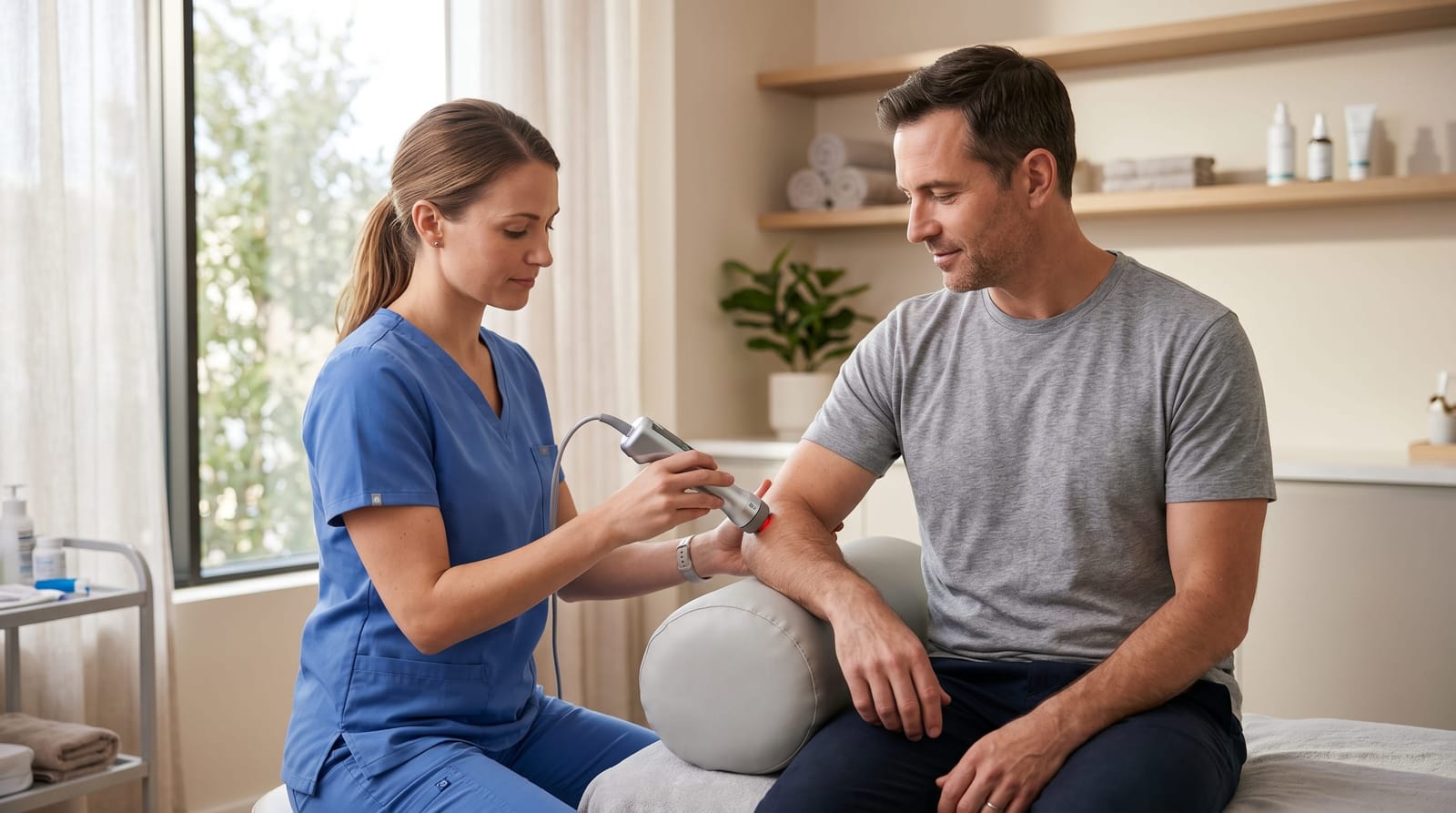
Class IV lasers deliver higher energy output than older low-level devices, which means deeper penetration into the tissue and potentially faster results: a meaningful difference when you're treating a condition as persistent as tennis elbow. Sessions are typically short, quiet, and comfortable, involving the practitioner guiding a handheld device over the outer elbow for several minutes.
How Many Sessions Should You Expect?
This is the question most people want answered first, and the honest answer is: it depends on how long you've had the condition and how severe it is. That said, clinical protocols and published research give us a reasonable framework.
Most cold laser treatment protocols for tennis elbow involve somewhere between 8 and 15 sessions, typically scheduled two to three times per week. Research published in peer-reviewed journals has used treatment protocols ranging from 6 to 12 sessions over three to six weeks, with meaningful improvements in pain scores and grip strength observed by the end of the treatment course.
Here's a general progression many patients experience:
- Sessions 1-4 (Week 1-2): This phase is primarily about reducing acute inflammation. Many patients report a modest but noticeable reduction in soreness during activities that previously aggravated the elbow. Grip-related discomfort may ease slightly.
- Sessions 5-8 (Weeks 2-3): Tissue repair starts to build momentum. Pain during rest often decreases, and some patients notice improved tolerance during work tasks or light exercise.
- Sessions 9-12 (Weeks 3-5): Functional improvement becomes more consistent. Grip strength and range of comfortable motion typically increase. Many patients in this range describe returning to activities they had modified or avoided.
Chronic cases, pain lasting six months or longer, may require additional sessions or a follow-up protocol. Acute cases caught early often respond faster.
Cold Laser Treatment vs. Cortisone Injections: What the Comparison Looks Like
Cortisone injections are one of the most commonly recommended treatments for tennis elbow, and they're effective at reducing pain quickly, often within a week or two. But there's an important nuance: the research suggests that while cortisone produces better short-term pain relief, outcomes at 6 and 12 months often favor conservative approaches like laser therapy, physical rehabilitation, or a combination of both.
A 2013 review of tennis elbow treatments found that cortisone injections had a recurrence rate significantly higher than wait-and-see or active rehabilitation approaches at the one-year mark. The short-term relief can mask the underlying tissue problem rather than resolve it.
Cold laser treatment takes longer to build results: it's not a one-week fix. But it works by supporting the tissue repair process rather than suppressing it. For patients who want results that hold up over time rather than symptom masking, that distinction matters. There's also no risk of the tendon weakening that can occur with repeated cortisone use.
It's worth noting that cortisone has a clear role in care for some patients, and that decision belongs with your healthcare provider. The comparison here is meant to help you understand the difference in mechanism and timeline, not to dismiss either approach outright.
Cold Laser vs. Surgery: A Very Different Risk Profile
Surgery for tennis elbow is typically reserved for cases that haven't responded after 6 to 12 months of conservative treatment. It usually involves removing damaged tendon tissue or releasing the attachment point. Recovery can take 3 to 6 months, and outcomes vary: some patients do very well, while others deal with scar tissue or residual weakness.
Cold laser treatment carries no procedural risk, no recovery period, and no structural changes to the tissue. For the majority of tennis elbow cases, which do respond to conservative care, surgery simply isn't necessary. Cold laser fits naturally into a broader non-surgical strategy that might also include soft tissue therapy, rehab exercises, and activity modification.
If you're exploring how different conservative approaches compare for elbow conditions, Tennis Elbow vs Golfer's Elbow: How Treatment Differs at a Chiropractic Clinic offers useful context on why treatment protocols differ based on which tendon is involved.
What Affects How Well Cold Laser Works for You
Not every patient responds identically, and a few factors influence outcomes:
- Duration of symptoms: Patients with pain lasting less than three months typically respond more quickly than those with chronic, long-standing cases.
- Activity levels during treatment: Continuing to perform repetitive gripping or lifting tasks without modification can slow progress, regardless of the therapy being used.
- Combination with other therapies: Cold laser is often most effective when paired with soft tissue work and a structured rehabilitation program targeting forearm strength and tendon loading.
- Device class and protocol: Not all laser devices are equivalent. Class IV systems deliver higher energy dosages than older Class III units, which affects depth of penetration and treatment efficiency.
Research on low-level laser therapy for tennis elbow shows mixed results across studies, partly because protocols, device types, and dosages vary widely between trials. When performed with appropriate equipment and a structured protocol, the evidence is more consistently positive, which is why asking about device type and treatment plan matters when you're evaluating a provider.
Frequently Asked Questions
Is cold laser treatment for tennis elbow painful?
No. Cold laser therapy is a gentle, comfortable procedure. Most patients feel nothing during treatment, though some describe a mild warming sensation. There's no discomfort during or after sessions, and no recovery time is needed.
How long does each cold laser session take?
Individual sessions typically last between 5 and 15 minutes depending on the area being treated and the device being used. Class IV lasers often require shorter treatment times due to higher energy output.
Can cold laser therapy help tennis elbow that's been going on for months?
Yes, though chronic cases often require more sessions than acute ones. Patients with long-standing tennis elbow may need 12 to 15 sessions and benefit most from a combined approach that includes rehabilitation exercises alongside laser therapy.
How soon after starting cold laser treatment will I notice a difference?
Many patients report some reduction in soreness during activity within the first two weeks of treatment. More meaningful functional improvements, better grip strength, less pain with daily tasks, typically become consistent between weeks three and five.
Putting It Together
Cold laser treatment for tennis elbow offers a structured, non-invasive path toward recovery that addresses the tissue problem rather than masking it. Most patients follow a protocol of 8 to 15 sessions over three to five weeks, with gradual improvements in pain, grip strength, and function throughout the course. Compared to cortisone injections, it builds more durable results over time; compared to surgery, it carries none of the recovery burden or procedural risk. If you're navigating treatment choices for upper extremity pain, understanding what each approach offers, and how they can work together, is the foundation of making a decision that serves your long-term wellness.